
LEGISLATION
MANUAL

UNIT STANDARD 244288
STUDENT NUMBER: XFS/LL/2016/023
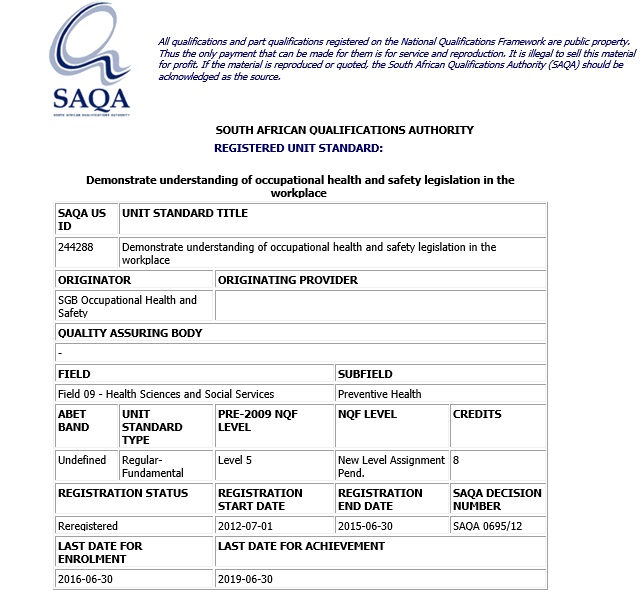
In all of the tables in this document, both the pre-2009 NQF Level and the NQF Level is shown. In the text (purpose statements, qualification rules, etc), any references to NQF Levels are to the pre-2009 levels unless specifically stated otherwise.
This unit standard does not replace any other unit standard and is not replaced by any other unit standard.
PURPOSE OF THE UNIT STANDARD
This unit standard enables learners to interpret health and safety legislation, and advise management on issues, which threaten the safety of people in the workplace.
Learners credited with this Unit Standard are capable of:
- • Discussing pertinent occupational health and safety legislation applicable to a specific workplace.
- • Discussing and explaining the application of the common law principles pertinent to health and safety in the workplace.
- • Explaining the principles of the law of delict and of criminal law applicable to an accident occurring in the workplace.
- • Applying the current Act for compensation for occupational injuries and diseases in the workplace.
LEARNING ASSUMED TO BE IN PLACE AND RECOGNITION OF PRIOR LEARNING
- • Mathematical skills at NQF Level 4.
- • Communication skills at NQF Level 4.
UNIT STANDARD RANGE
N/A
Specific Outcomes and Assessment Criteria:
SPECIFIC OUTCOME 1
Discuss pertinent occupational health and safety legislation applicable to a specific workplace.
ASSESSMENT CRITERIA
ASSESSMENT CRITERION 1
Relevant safety legislative and other requirements, directly related to safety practice including acts, codes of practice and SABS standards are identified.
ASSESSMENT CRITERION 2
The general aims and objectives of relevant safety laws are explained and the practical implications of all the relevant acts for safety practice in the workplace are stated.
ASSESSMENT CRITERION 3
The legal rights and responsibilities of employees, employers, line managers, safety representatives, safety committees, visitors, contractors, manufacturers, and suppliers are explained.
SPECIFIC OUTCOME 2
Discuss and explain the application of the common law principles pertinent to health and safety in the workplace.
ASSESSMENT CRITERIA
ASSESSMENT CRITERION 1
The principles of common law applicable to health and safety in the workplace are identified and applied to any given case study relevant to the workplace.
ASSESSMENT CRITERION 2
An opinion is provided on the legal position of all involved parties in the given case study in terms of the common law principles applicable to health and safety in the workplace.
SPECIFIC OUTCOME 3
Explain the principles of the law of delict and of criminal law pertinent to an accident occurring in the workplace.
ASSESSMENT CRITERION 1
The relevant principles of the law of delict and criminal law applicable to an accident that occurred in the workplace are identified.
ASSESSMENT CRITERION 2
The criminal and/or civil liability of a negligent party in terms of the principles of the law of delict and/or criminal law is described.
SPECIFIC OUTCOME 4
Apply the current Act for compensation for occupational injuries and diseases in the workplace.
ASSESSMENT CRITERION 1
The relevant sections of the current Act for compensation for occupational injuries and diseases are applied to any given case study.
ASSESSMENT CRITERION 2
An opinion on the legal position of both the employer and the injured party in any given case study in terms of the current legislation for compensation for occupational injuries and diseases is stated and motivated.
UNIT STANDARD ACCREDITATION AND MODERATION OPTIONS
- Anyone assessing a learner against this unit standard must be registered as an assessor with the relevant ETQA or another ETQA that has a Memorandum of Understanding with the relevant ETQA.
- Any institution offering learning that will enable achievement of this unit standard must be accredited as a provider through the relevant ETQA by SAQA.
- Moderation of assessment will be overseen by the relevant ETQA according to the moderation guidelines and the agreed ETQA procedures.
UNIT STANDARD ESSENTIAL EMBEDDED KNOWLEDGE
Specified Requirements:
Specified requirements include legal and site-specific requirements and are contained in one or more of the following categories of documentations:
• Legal:
Include, but not limited to, pertinent sections of legislation including associated regulations and other supporting documentation.
Range:
- > Occupational health, safety and environment.
- > Mining and minerals.
- > Local government.
- > Mandatory codes of practice.
- > Safety standards.
• Site Specific:
- > Hazard Identification and Risk Assessments (HIRA).
- > Occupational Health and Safety Risk Management Programme.
- > Managerial Instructions.
- > Mine Standard Procedures.
- > List of Recorded OH&S Risks.
- > Working Guides.
- > Equipment and Materials Specifications.
UNIT STANDARD DEVELOPMENTAL OUTCOME
N/A
UNIT STANDARD LINKAGES
N/A
Critical Cross-field Outcomes (CCFO):
UNIT STANDARD CCFO IDENTIFYING
Identify and solve problems and make decisions using critical and creative thinking.
Note:
• By applying OHS Legislation the individual will be required to have a basic knowledge on the specific requirements of the workplace and so be able to solve problems and make decisions.
UNIT STANDARD CCFO WORKING
Work effectively with others as members of a team, group, organisation or community.
Note:
• The individual will have to take an active part in applying OHS Legislation to ensure the requirements and needs of the represented people are addressed.
UNIT STANDARD CCFO ORGANISING
Organise and manage themselves and their activities responsibly and effectively.
Note:
• As part of the team, the individual will take into account the activities around him/her and ensure that his/her actions are complementary.
UNIT STANDARD CCFO COLLECTING
Collect, organise, analyse and critically evaluate information.
Note:
• When participating in applying OHS Legislation, the individual will have to collect, organize and evaluate information in such a way that he/she will be able to contribute to decision-making.
UNIT STANDARD CCFO COMMUNICATING
Communicate effectively using visual, mathematics and/or language skills in the modes of oral and written presentations.
Note:
• The expectations and contributions of the represented people is communicated during applying OHS Legislation and feedback on the progress and results of the programme is provided.
UNIT STANDARD CCFO SCIENCE
Use science and technology effectively and critically showing responsibility towards the environment and health of others.
Note:
• Science and technology are used at the appropriate level, e.g. in interpreting statistical data.
UNIT STANDARD CCFO DEMONSTRATING
Demonstrate an understanding of the world as a set of related systems by recognising that problem-solving contexts do not exist in isolation.
Note:
• He/she must understand the impact of applying OHS Legislation on the overall objectives of the working place.
QUALIFICATIONS UTILISING THIS UNIT STANDARD:
