
SAFETY OFFICER

UNIT STANDARD – 110526

| SOUTH AFRICAN QUALIFICATIONS AUTHORITY |
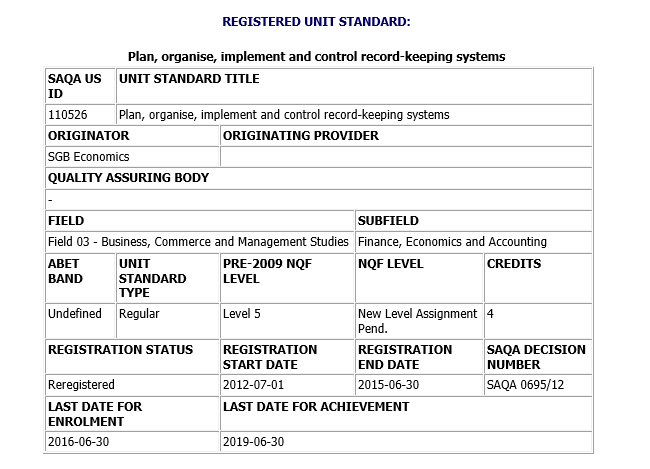
In all of the tables in this document, both the pre-2009 NQF Level and the NQF Level is shown. In the text (purpose statements, qualification rules, etc), any references to NQF Levels are to the pre-2009 levels unless specifically stated otherwise.
This unit standard does not replace any other unit standard and is not replaced by any other unit standard.
PURPOSE OF THE UNIT STANDARD
This unit standard is intended for people who are employed at a supervisory level in an area where record keeping is vital. People credited with this unit standard are able to:
• Create a record keeping system
• Maintain and update the record keeping system
• Locate and provide records to users on request
LEARNING ASSUMED TO BE IN PLACE AND RECOGNITION OF PRIOR LEARNING
It is assumed that +learners are competent in:
• Communication at NQF Level 4
• Computer Literacy at NQF Level 4
• Mathematical Literacy NQF Level 4
UNIT STANDARD RANGE
Records to be kept include: project plan; contracts; minutes of meetings; budgets; invoices; financial statements; reports; contact details of stakeholders and role players
Specific Outcomes and Assessment Criteria:
SPECIFIC OUTCOME 1
Create a record keeping system.
ASSESSMENT CRITERIA
ASSESSMENT CRITERION 1
1. Record keeping system is created and implemented for a specific local economic development project or programme.
ASSESSMENT CRITERION 2
2. Record keeping system is cost effective and meets the needs of the specific local economic development project or programme
ASSESSMENT CRITERION 3
3. Record keeping system is practical and meets the needs of the specific local economic development project or programme
SPECIFIC OUTCOME 2
Maintain and update the record keeping system.
ASSESSMENT CRITERIA
ASSESSMENT CRITERION 1
1. Data captured is relevant on terms of the intended purpose
ASSESSMENT CRITERION 2
2. Data is collated systematically and timeously in accordance with the specific requirements of the local economic development project or programme
ASSESSMENT CRITERION 3
3. Data is presented in an appropriate format
ASSESSMENT CRITERION 4
4. The record keeping system is monitored and reviewed in accordance with best practice
SPECIFIC OUTCOME 3
Locate and provide records to users on request.
ASSESSMENT CRITERIA
ASSESSMENT CRITERION 1
1. The record retrieval process is specified and adhered to according to policy and procedures in own work context
ASSESSMENT CRITERION 2
2. The requested data is located, accessed and retrieved timeously and in terms of the user`s request
ASSESSMENT CRITERION 3
3. The confidentiality of records is maintained and security procedures are explained in own work context
UNIT STANDARD ACCREDITATION AND MODERATION OPTIONS
1. Anyone assessing a learner against this unit standard must be registered as an assessor with the relevant ETQA.
2. Any institution offering learning that will enable achievement of this unit standard or will assess this unit standard must be accredited as a provider with the relevant ETQA.
3. Moderation of assessment will be overseen by the relevant ETQA according to the moderation guidelines in the relevant qualification and the agreed ETQA procedures.
4. Therefore, anyone wishing to be assessed against this unit standard may apply to be assessed by any assessment agency, assessor or provider institution that is accredited by the relevant ETQA.
UNIT STANDARD ESSENTIAL EMBEDDED KNOWLEDGE
• Structure of record keeping systems.
• Controls of record keeping systems.
• Policies and procedures for data storage, retrieval and distribution.
UNIT STANDARD DEVELOPMENTAL OUTCOME
N/A
UNIT STANDARD LINKAGES
N/A
Critical Cross-field Outcomes (CCFO):
UNIT STANDARD CCFO IDENTIFYING
Identify and solve problems in which responses display that responsible decisions using critical and creative thinking have been made by, e.g.
• Monitoring and reviewing the record keeping system in accordance with best practice according to assessment criterion 4.4
UNIT STANDARD CCFO WORKING
Work effectively with others as a member of a team, group, organization and community by, e.g.
• Collating data systematically and timeously in accordance with the specific requirements of the local economic development project or programme according to assessment criterion:
Data is collated systematically and timeously in accordance with the specific requirements of the local economic development project or programme
• Locating, accessing and retrieving the requested data timeously and in terms of the user`s request according to assessment criterion:
The requested data is located, accessed and retrieved timeously and in terms of the user`s request
UNIT STANDARD CCFO ORGANISING
Organise and manage oneself and one`s activities responsibly and effectively by, e.g.
• Collating data systematically and timeously in accordance with the specific requirements of the local economic development project or programme according to assessment criterion:
Data is collated systematically and timeously in accordance with the specific requirements of the local economic development project or programme
• Locating, accessing and retrieving the requested data timeously and in terms of the user`s request according to assessment criterion:
The requested data is located, accessed and retrieved timeously and in terms of the user`s request
UNIT STANDARD CCFO COLLECTING
Collect, analyse, organize and critically evaluate information by, e.g.
• Creating a record keeping system according to the assessment criteria for specific outcome:
Create a record keeping system
• Maintaining and updating the record keeping system according to the assessment criteria for specific outcome:
Maintain and update the record keeping system
UNIT STANDARD CCFO SCIENCE
Use science and technology effectively and critically, showing responsibility towards the environments and health of others by, eg.
• Planning, organising, implementing and controlling record keeping systems according to the assessment criteria for specific outcomes:
Create a record keeping system
Maintain and update the record keeping system
Locate and provide records to users on request